Alshemal Norway · Live Arctic Sky Radar
Live Aurora Sky Webcams
Real-time multi-angle (North, South, East, West & 180° All-Sky) observatory feeds sorted North to South from 70.09°N Nuorgam & 69.68°N Tromsø down to 59.10°N Southern Norway & Helsinki.
Select Live Camera Region or 250 km Chase Corridor
Select a region below, then tap the Compass Angles (N / S / E / W / Sky) inside each colored station card to rotate around the horizon in real time:
NOAA SWPC L1 & GOES-18 Satellite Watch · Real-Time Solar-Terrestrial Physics
Live NOAA Auroral Oval, Solar Wind Graph & Sun Watch Containers
Track the real-time 2-hour SOLAR1 IMF Bz & Solar Wind Plasma Graph alongside interactive 24-hour time-lapse NOAA satellite feeds of the Northern Hemisphere Auroral Oval, GOES-18 SUVI Sun Corona, LASCO / CCOR-1 CME Coronagraphs, and WSA-Enlil Solar Wind Spiral:
Original 4K Aurora Borealis Field Release · Tromsø & Skibotn Corridor
Crown of the Aurora: What an Overhead Substorm Looks Like in Our 250 km Chase Corridor
When the live NOAA DSCOVR Bz gauge above tilts southward and our 8-guest 2026 Mercedes-Benz Sprinter 319 4×4 routes beneath clear skies in Kvaløya, Skibotn, or Kilpisjärvi, the auroral corona erupts directly overhead. Watch our original 4K field release filmed across Northern Norway.
- Why Camera Sensors See Green Before the Naked Eye
- Observatory all-sky domes and our guides' Sony A7IV / Canon R6 full-frame cameras capture 557.7 nm atomic oxygen emissions during early substorm growth phases, guiding our 4×4 positioning before the naked-eye corona breaks.
- 24-Hour Unwatermarked RAW + JPEG Cloud Delivery
- Every guest on our nightly 8-guest 4×4 chases receives unlimited high-resolution portraits and aurora landscape frames delivered in both unwatermarked RAW (.ARW/.CR3) and JPEG formats within 24 hours.
- Geomagnetic Oval
- 67.4° N Overhead at Kp 0–1
- 3-Zone Chase Radius
- 250 km 125+ 4×4 turnouts
- Skibotn Rain Shadow
- 338 mm vs. 1,091 mm coast
- Maximum Guests
- 8 Guests 2026 Sprinter 319 4×4
- Thermal Protection
- -40 °C Regatta suits + 5.5 kW heat
- 3-Year Sighting Rate
- 94% 24h RAW/JPEG delivery
Direct 8-Guest 4×4 Arctic Expeditions from Tromsø
Step beneath the live sky corridors above inside our climate-controlled 2026 Mercedes-Benz Sprinter 319 4×4 fleet—engineered for 250 km tri-zonal weather routing, -40°C thermal comfort, and 100% fee-free cancellation up to 24 hours before departure:
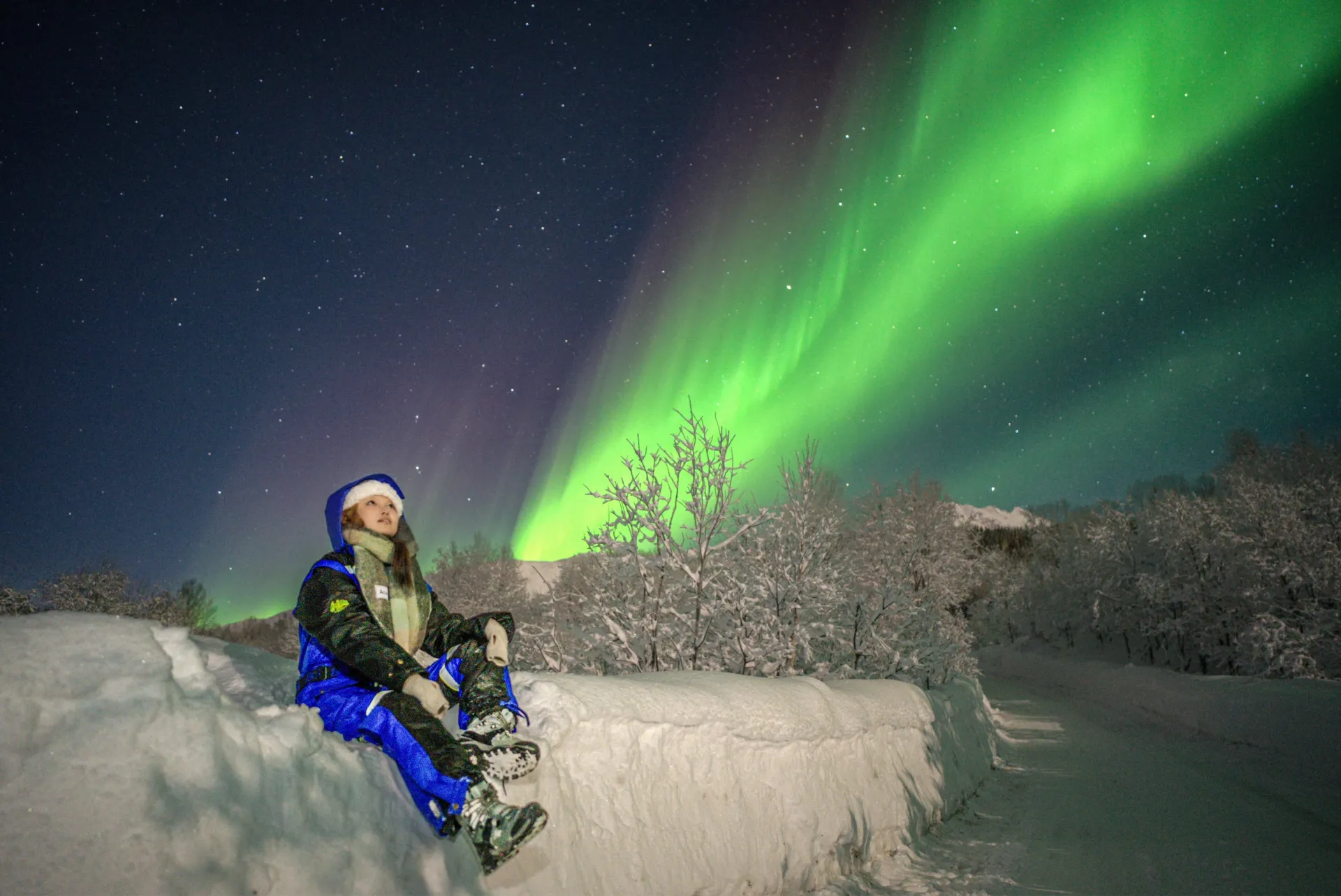
94% 3-year verified sighting rate across Kvaløya, Skibotn, and Kilpisjärvi (Finland). Includes -40°C Regatta thermal suits (confirmable until departure day), +21°C Webasto cabin heat, campfire snacks, and 24h unwatermarked Sony A7IV / Canon R6 RAW + JPEG portraits.
Book Night Aurora Chase →
Choose our 5-Hour Kvaløya & Sommarøy Fjord Tour (8,900 NOK) or our 9-Hour, 330 km Private Senja Grand Circle Loop (14,900 NOK) with Brensholmen ferry tickets, Tungeneset ("Devil's Teeth"), Bergsbotn Platform, and overland Gisund Bridge & Nordkjosbotn return.
Explore Fjord & Senja Tours →
Bridges the TOS Airport / hotel check-in gap (only 667.50 NOK/guest at 8 guests) with +21°C heated suitcase storage, pre-paid admission to The Polar Museum & The Arctic University Museum, Telegrafbukta & Lake Prestvannet. Communicate luggage count/sizes in advance.
Book Island & Museum Tour →Live Aurora Webcams, NOAA Solar Satellites, Arctic Layering & Dispatch FAQs
Everything you need to interpret our 66 live sky hubs, 2-hour NOAA SOLAR-1 solar wind graph, 24-hour satellite time-lapse players, sub-zero inland microclimates, and Tromsø expedition logistics:
1. How can I use these live webcams to know what to wear for tonight's Northern Lights chase?
Compare the coastal Tromsø cameras (often hovering around -2°C to +2°C with maritime air) against our inland Lyngen Alps, Skibotn, Setermoen 2K, and Kilpisjärvi border cameras, where clear continental skies rapidly drop temperatures to -15°C to -30°C. Always start with 100% merino wool base layers, a wool or fleece mid-layer, wool socks, and your own insulated winter boots. Every guest on our 8-Guest 4×4 Northern Lights Chases is outfitted with a complimentary commercial-grade -40°C Regatta Thermo-Cruiser suit(Adult XS–XXXL & Youth 110–145 cm, confirmable right up until departure day) plus +21°C Webasto cabin heating. Read our complete What to Wear for Northern Lights in Tromsø Layering Guide.
2. Which live cameras show Tromsø Harbor, Fjellstua (Storsteinen 2K), and cruise ship weather conditions?
Select the "Norway & Svalbard" tab (or "180° All-Sky Flagships") to view Norway · Tromsø & Fjellstua (69.65°N, 18.98°E) —which features direct 2K feeds from Fjellstua Cam 1 & Cam 2 looking north and west across Tromsø Sound, the Vervet 24/7 Live Harbor & South Sky Stream, and the Fjellheisen 360° Panorama —alongside Norway · Tromsø University (3K West, East & North). Because municipal Bus 42 stops running at 00:30, our Cruise-Safe 8-Guest Night Aurora Excursion drops you directly at the Breivika Quay 24–25 security gate after midnight. See our Cruising to Tromsø Shore Excursion & Midnight Port Logistics Guide.
3. Why is a mobile 8-guest 4×4 Sprinter chase far more effective than watching from the stationary Fjellheisen Cable Car?
We include the Fjellstua 2K (Cams 1 & 2) and Fjellheisen 360° feeds on this page so travelers can audit coastal cloud ceilings above Tromsøya in real time, but Alshemal Norway does not sell cable car tickets. The upper station at Storsteinen (421m) suffers from three major aurora-chasing handicaps: (1) moist westerly winds from the Norwegian Sea condense against the mountain ridge, creating localized orographic cloud caps even when inland valleys are crystal clear; (2) intense upward city glare from Tromsøya washes out faint substorms; and (3) a stationary platform offers zero mobility when coastal snow squalls roll in. Instead, our 8-Guest 2026 Mercedes-Benz Sprinter 319 4×4 fleet routes up to 250 km beneath and behind the mountain ranges into 125+ zero-light-pollution wilderness turnouts.
4. What should we do if the Tromsø coastal webcams show 100% cloud cover or heavy snow?
Never cancel your aurora chase based on coastal Tromsø weather. Coastal Tromsø receives 1,091 mm of annual precipitation, whereas the 1,800m Lyngen Alps block wet Atlantic fronts to create a dry 338 mm continental rain shadow in the Skibotn Valley (69.35°N), inland Setermoen / Bardufoss (69.06°N), and across the Finnish border in Kilpisjärvi (69.05°N). Check Norway · Lyngen Alps(LYNGEN LIVE 24/7 stream & LYNGEN NE/SE), Norway · Skibotn(BACC5 185° Dome), Norway · Senja & Bardufoss(SETERMOEN 2K), and the "Finland & Lapland" tab (Finland · Kilpisjärvi & Saana) to watch the inland corridor clear up, or book our Northern Lights Small Group + Finland Crossing (Max 8)(remember to bring your physical passport or EU ID card).
5. Why can we see bright Northern Lights on the Tromsø, Lyngen & Skibotn cameras even when Kp is 0 or 1?
Planetary Kp is a delayed 3-hour global average designed for lower latitudes like Southern Norway, Scotland, or the northern United States. Tromsø (69.65°N geographic / 67.4°N geomagnetic latitude) sits directly underneath the permanent Auroral Oval. Whenever the IMF Bz Vector in our live NOAA SOLAR-1 console above tilts southward (negative nT), solar wind plasma couples directly with Earth's magnetosphere and ignites overhead auroras at Kp 0–1. Learn more in our Space Weather in Tromsø: Kp Index, Bz & Solar Wind Guide.
6. How do I read the Live 2-Hour NOAA SOLAR-1 Magnetic Field (Bt/Bz) & Solar Wind Graph below the camera grid?
Directly below the regional camera cards, our real-time canvas chart plots the last 120 minutes of active L1 space-weather telemetry from NOAA's operational SOLAR-1
spacecraft: (1) White Curve (Total Field Bt):
shows total interplanetary magnetic field strength in nanoTeslas (nT); (2) Red Curve & Crimson Shading (IMF Bz):
tracks the north-south magnetic orientation—whenever the red line drops below the dashed 0 nT
centerline into the red-shaded southward zone, magnetic reconnection is active and substorms erupt over Tromsø within 30–45 minutes; and (3) Yellow Curve (Solar Wind Speed km/s):
tracks plasma velocity arriving from coronal holes or CMEs.
7. How do the 4 NOAA Satellite Watch Containers and 24-Hour Time-Lapse Players help forecast auroras?
Each of the 4 satellite cards in our NOAA Watch Hub includes a "Play 24h Time-Lapse" button and interactive frame scrubber connected directly to NOAA SWPC's satellite animation playlists: (1) NOAA · Auroral Oval Radar: animates the Northern & Southern Hemisphere Ovation auroral ring over Norway, Svalbard, and Lapland alongside the 3-hour Station Kp chart; (2) NOAA · Live Sun & Corona (GOES-18 SUVI): switches between 195Å (dark coronal holes that fire fast solar wind streams), 304Å (solar prominences), and 131Å (extreme solar flares); (3) NOAA · CME Coronagraphs: combines SOHO LASCO C3/C2 and GOES-19 CCOR-1 to track Coronal Mass Ejections blasting outward from the Sun; and (4) NOAA · Solar Wind Spiral: displays the WSA-Enlil heliospheric plasma spiral, Global D-RAP X-ray absorption, and SDO HMI sunspot groups.
8. We land at Tromsø Airport (TOS) before 15:00 hotel check-in—how can we explore with our suitcases?
Instead of paying for a taxi only to leave bags in an unheated hotel lobby until 15:00, book our 3-Hour Private Tromsø Island, 2-Museums & +21°C Luggage Tour (5,340 NOK for 1–8 guests). We collect your group directly at TOS Airport, keep all suitcases warm inside our 4×4 Sprinter, include pre-paid tickets to The Polar Museum & The Arctic University Museum, visit Telegrafbukta and Lake Prestvannet, and deliver you to your hotel at check-in time (please communicate suitcase count and dimensions in advance). Read our Tromsø Island & Museums Luggage Logistics Guide.
9. Can we use these cameras to preview Kvaløya, Vannøya, Andøya & Lofoten daytime fjord light before our tour?
Yes. Under the "Norway & Svalbard" tab, check Norway · Tromsø University (WEST 3K Toward Kvaløya), Norway · Tromsø & Fjellstua (FJELLSTUA 2 2K), Norway · Vannøya & Skjervøy (VANNØYA 1 & 2 2K), and Norway · Andøya & Lofoten (RISØYHAMN 1–3 2K & LOFOTEN SKY) during the 09:30–14:30 polar twilight window. We operate 100% private 5-hour daytime fjord expeditions across South Coast & Sommarøy Archipelago, Mid Coast & Ersfjordbotn, and North Coast Wilderness(8,900 NOK per private group of 1–8 guests), leaving a 4-hour rest buffer before your evening aurora chase.
10. How do I switch camera angles, stamp & save a 1280px telemetry sky photo, or ask the AI Concierge?
Tap any button inside the Select Sky Camera box on any station card to switch directions immediately, or click Enlarge & Stamp Photo to open the fullscreen lightbox with live animated NOAA telemetry bars. Inside the modal, click Stamp & Save Sky Photo to download a 1280px–1920px image stamped with the exact UTC/CET timestamp, GPS coordinates, camera source, and live Kp/Bz/Wind readings. For custom route or pickup questions, use the AI Concierge bar above or open our AI Arctic Trip Planner.
How to Read the Live Aurora Telemetry & Geomagnetic Storm Numbers in Tromsø
Most travelers misread standard aurora apps because they are calibrated for central Europe or North America. Here is how our meteorologists and 4×4 guides decode the 4 live NOAA DSCOVR L1 metrics at Tromsø's 69.65°N latitude:
The Interplanetary Magnetic Field ( IMF Bz) measures the north-south orientation of the solar wind magnetic field arriving at the DSCOVR satellite 1.5 million km upstream of Earth. When Bz tilts negative (Southward, e.g., -2 nT to -15 nT), our Bz card glows soft lemon-yellow because the solar wind unlocks Earth's magnetosphere via magnetic reconnection—pouring charged particles directly into Tromsø's sky within 30 to 45 minutes. Read our Complete Kp & Bz Space Weather Guide.
The Kp-index (0 to 9) measures global geomagnetic disturbance averaged over 3-hour blocks. Because Tromsø sits at 67.4°N geomagnetic latitude directly underneath the quiet-time Auroral Oval, you do not need a high Kp score here: Kp 0 to Kp 2 delivers overhead green arcs across Kvaløya and Skibotn whenever skies are clear. When Kp rises to Kp 4–8 (G1 to G4 Geomagnetic Storms), crimson nitrogen fringes erupt and the oval expands south to Trondheim, Oslo, and Helsinki.
Ambient solar wind flows at 300–380 km/s. When a solar Coronal Hole High-Speed Stream (CH HSS) or Coronal Mass Ejection (CME) impacts L1, wind speeds jump to 450–750+ km/s and proton density spikes above 10–25 p/cm³. High velocity combined with southward Bz creates rapid, dancing auroral curtains that require fast shutter speeds (1.0s to 2.5s at ISO 3200, f/1.4–f/2.8)—see our Pro Northern Lights Camera Settings Guide.
Total Interplanetary Magnetic Field (Bt) represents the total magnetic energy carried by the solar wind (typically 4 nT to 25+ nT). A high Bt (> 8 nT) means the solar wind is loaded with magnetic energy; the moment Bz flips negative, that stored energy releases in an explosive magnetospheric substorm. Learn why our Science Behind the Northern Lights Guide and 8-Guest 4×4 Chases position you under clear skies before breakup.
Why Live Multi-Angle Telemetry + 8-Guest 4×4 Routing Beats Weather Apps & Coaches
Single-point smartphone weather apps do not account for High Arctic orographic rain shadows, stationary mountain cloud caps, or EU tachograph limits:
